Vision Correction Options
When it comes to vision correction, there are several effective options available that cater to different needs and preferences. The most common methods include glasses, contact lenses, and various surgical procedures. Glasses are perhaps the most traditional solution, offering a straightforward way to correct vision without any invasive procedures. They come in various styles and lenses tailored to specific vision issues such as nearsightedness, farsightedness, and astigmatism. Not only are they practical, but they also serve as a fashion statement for many, allowing people to express their personal style.
Contact lenses offer another flexible alternative, providing clear vision without the bulk of frames. They sit directly on the eye, offering a wider field of view and greater comfort for active lifestyles. For those seeking a more permanent solution, surgical options such as LASIK, PRK, and SMILE continue to gain popularity. These procedures use advanced laser technology to reshape the cornea and correct refractive errors, often allowing patients to achieve 20/25 vision or better. However, it’s essential for individuals considering surgery to consult with a qualified ophthalmologist to evaluate their candidacy and understand the risks involved. Each vision correction option has its unique benefits and considerations, making it crucial to weigh them carefully when deciding on the best approach for individual needs.
Comprehensive Vision Correction: Non-Surgical and Surgical Solutions
Vision correction describes the range of optical and procedural approaches used to reduce refractive error and improve functional eyesight, from spectacles and contact lenses to corneal reshaping and refractive surgery. This article explains the mechanisms behind each major option—glasses, progressive lenses, contact lenses, orthokeratology (Ortho-K), and LASIK—so you can compare how they work, who benefits, and what to expect clinically. At Eyes On Park, our commitment is to provide evidence-based guidance and cutting-edge solutions tailored to your unique visual needs.
Readers will learn how comprehensive eye exams determine candidacy, how pediatric myopia control differs from adult presbyopia strategies, and how ocular surface health affects lens choices. The guide also covers practical considerations such as adaptation timelines, follow-up schedules, insurance basics, and real-world comparisons to help decide between temporary and permanent correction routes. Finally, several sections connect these clinical options to local, patient-focused care pathways available from Eyes On Park in Gramercy Park, NYC, including co-management for refractive surgery and Ortho-K evaluation for children.
What Are the Main Types of Vision Correction Options Available?
Vision correction options fall into broad non-surgical and surgical categories, each using a different mechanism to direct light to the retina and improve clarity. Non-surgical choices—eyeglasses, progressive lenses, and contact lenses—use external optics to correct refractive errors, while orthokeratology temporarily reshapes the cornea overnight to produce daytime clarity without wear.
Surgical options like LASIK permanently alter corneal tissue to correct prescription errors. Understanding these categories helps patients weigh reversibility, convenience, risk, and cost when selecting a pathway. The following H3 sections unpack how each major option works, typical use-cases, and what patients can expect during selection and adaptation.
How Do Glasses Correct Vision and What Are the Latest Frame Styles?
Glasses correct vision by placing corrective lenses in front of the eye that change the focal point of incoming light so it lands on the retina rather than in front of or behind it. Single-vision lenses correct distance or near prescriptions, while progressive eyeglass lenses combine multiple focal powers seamlessly for presbyopia.
Lens coatings and materials—such as high-index lenses and blue-light filtering coatings—affect comfort and weight, and choices should consider lifestyle needs like driving or prolonged screen use. Frame style trends emphasize lightweight materials, adjustable nose pads, and narrower temples for mask compatibility, but the primary selection metric remains proper optical centration and accurate pupillary distance measurement. Proper frame fit and precision lens fabrication optimize visual performance and minimize adaptation issues.
What Are Progressive Lenses and How Do They Improve Vision?
Progressive lenses are multifocal spectacle lenses that provide a continuous gradient of optical power from distance through intermediate to near vision without visible lines, enabling seamless transitions across tasks. The lens design contains distinct zones—distance at the top, intermediate in the center, and near at the bottom—arranged so eye movement provides the appropriate focal power for each activity.
Compared with lined bifocals or trifocals, progressives offer aesthetic advantages and reduced image jump, but they require precise fitting measurements and a short adaptation period for many wearers. Proper centration, frame choice, and dispensing adjustments reduce peripheral aberrations and improve comfort for occupations requiring frequent shifts between screens and reading.
What Types of Contact Lenses Are Offered and How Do They Differ?
Contact lenses correct refractive error by sitting directly on the cornea or tear film, offering wider visual fields and fewer optical distortions for many activities compared with glasses. Major categories include daily disposables, monthly disposables, silicone hydrogel lenses for high oxygen transmission, toric lenses for astigmatism, multifocal lenses for presbyopia, and rigid gas permeable (RGP) lenses that provide superior optical precision for irregular corneas.
Material choice affects oxygen permeability, wettability, and suitability for dry eye; wear schedule affects hygiene and infection risk. Contact lens fitting involves assessing ocular surface health, tear film quality, and daily habits to match a lens that balances comfort, convenience, and visual performance.
How Does Orthokeratology Work as a Non-Surgical Vision Correction Method?
Orthokeratology (Ortho-K) uses specially designed rigid contact lenses worn overnight to temporarily flatten the central cornea and redistribute epithelial cells, so daytime vision is improved without daytime lens wear. The mechanism is reversible and relies on precisely fitted RGP-style lenses that reshape corneal curvature to correct low-to-moderate myopia and, in some designs, mild astigmatism.
Ortho-K is particularly attractive for children and active adults who want freedom from daytime lenses or spectacles, and it is supported by clinical evidence indicating reduced myopia progression in many pediatric cases. Success requires careful fitting, initial frequent follow-ups, and ongoing monitoring to maintain corneal health and consistent daytime acuity.
When Is LASIK Surgery Considered and How Does Co-Management Work?
LASIK is considered for patients with stable refractive error, sufficient corneal thickness, healthy ocular surface, and realistic expectations about outcomes and risks; candidacy is determined through comprehensive pre-operative testing. The surgery reshapes corneal tissue with a laser to correct myopia, hyperopia, and astigmatism, typically producing rapid visual recovery but requiring informed consent and understanding of potential side effects.
Co-management by optometrists and surgical centers means optometrists perform detailed pre-op diagnostics, coordinate care with the surgical team, and provide post-operative follow-up and visual rehabilitation. Patients considering LASIK should have a thorough exam to assess ocular surface, corneal topography, and overall ocular health before referral to a refractive surgeon.
How Do Comprehensive Eye Exams Support Effective Vision Correction?
Comprehensive eye exams are the diagnostic foundation for safe, effective vision correction because they quantify refractive error and evaluate ocular health markers that influence candidacy and ongoing safety. An exam typically includes history intake, objective refraction, subjective refraction, slit-lamp evaluation, intraocular pressure check, corneal topography or tomography when indicated, and retinal imaging or dilated fundus exam as needed.
These assessments detect conditions such as irregular corneas, dry eye, early glaucoma, or retinal disease that can alter recommended correction strategies or require treatment before lens fitting or surgery. Regular exams establish baselines, detect progression (myopia in children, presbyopia in adults), and guide personalized recommendations for glasses, contacts, Ortho-K, or surgical referral.
What Happens During a Comprehensive Eye Exam at Eyes On Park NYC?
At Eyes On Park NYC, our comprehensive exam is conducted by expert clinicians and begins with a detailed patient history and symptom review, followed by objective measurements and refraction to determine precise prescription needs. Our team utilizes state-of-the-art diagnostic equipment—such as advanced corneal imaging, ocular surface evaluation, and high-resolution retinal photography—to meticulously assess corneal shape, tear-film quality, and retinal health, all of which are crucial for informing contact lens fitting and surgical candidacy.
After testing, the optometrist discusses tailored correction options, explains trade-offs between glasses, contacts, Ortho-K, and surgery, and outlines follow-up plans or referrals when needed. Scheduling and follow-up are coordinated to ensure continuity of care, and visual rehabilitation or lens trials are arranged when appropriate to confirm real-world performance.
Why Are Annual Eye Exams Important for Maintaining Eye Health?
Annual eye exams detect refractive changes and ocular disease early, when interventions are most effective, and they are particularly important for monitoring myopia progression in children and presbyopic changes in adults. Regular screening identifies conditions like glaucoma, macular degeneration, diabetic retinopathy, and dry eye disease before symptomatic decline, allowing treatment or lifestyle adjustments that preserve vision.
For contact lens wearers and Ortho-K patients, more frequent follow-ups ensure the ocular surface remains healthy and lenses continue to fit properly. Maintaining an annual or schedule-appropriate exam cadence supports proactive management of vision and long-term ocular health.
How Are Pediatric Eye Exams Different and Why Are They Crucial for Children?
Pediatric eye exams use age-appropriate testing methods to evaluate refractive status, binocular vision, and developmental markers like amblyopia and strabismus that can affect learning and motor skills. Children may not report symptoms, so objective screening and play-based testing reveal issues such as unequal refractive error or coordination problems that interfere with classroom performance.
Early detection enables interventions including glasses, vision therapy, or myopia-control options such as Ortho-K when suitable, reducing risk of progressive vision loss. Pediatric exams also include counseling for parents on visual milestones, screen-time management, and follow-up intervals critical for tracking visual development.
What Are the Benefits and Suitability of Orthokeratology for Vision Correction?

Orthokeratology offers daytime spectacle-free vision by overnight corneal reshaping and can be an effective myopia control strategy in children, combining functional convenience with potential long-term benefits. The primary advantages include daytime freedom from lenses or spectacles, suitability for sports and outdoor activities, and growing evidence that Ortho-K slows myopia progression in many pediatric patients.
Risks are limited but include contact-lens–related infection risk, lens compliance demands, and the need for regular monitoring; candidacy depends on corneal health and specific refractive ranges. For families and adults seeking non-surgical, reversible solutions, Ortho-K is a strong option when fitted and followed by experienced clinicians.
- Key Ortho-K benefits include daytime freedom, myopia control potential, and reversibility.
- Considerations include rigorous hygiene, frequent early follow-ups, and candidacy screening.
- Typical monitoring includes overnight fits, 1-week and 1-month checks, then periodic reviews.
This list outlines the core patient-facing features to weigh when considering Ortho-K, summarized from current clinical practice and myopia-control studies. Understanding these benefits and trade-offs clarifies how Ortho-K fits among other correction strategies and leads naturally to practical details about evidence and day-to-day outcomes covered below.
How Does Ortho-K Control Myopia Progression in Children?
Ortho-K appears to reduce axial elongation by altering peripheral retinal defocus through corneal reshaping, which in turn influences eye growth signals associated with myopia progression. Clinical studies indicate that children wearing properly fitted Ortho-K lenses often show slower progression compared with single-vision spectacle wearers, with effect sizes varying by age, baseline myopia, and adherence.
The mechanism is hypothesized to involve central flattening and peripheral steepening that reduces hyperopic defocus on peripheral retina, signaling slower ocular elongation. Regular monitoring of axial length and corneal topography is essential to confirm efficacy and adjust treatment for each child.
Research conducted in mainland China demonstrated that orthokeratology was effective in controlling myopia progression in children when compared to single-vision spectacle lenses.
Orthokeratology for Myopia Control in Children: A Chinese Study
In mainland China, an analysis based on medical records of 65 orthokeratology treated children and 63 children corrected with single‐vision spectacle lenses, showed that orthokeratology was effective in controlling myopia progression.
The efficacy of Ortho-K for myopia control has been well-established in numerous studies, showing a greater effect in children with higher baseline myopia, though it cannot completely halt progression.
Review of Orthokeratology Efficacy in Myopia Control for Children
Although it cannot halt myopia progression completely, the efficacy of OK for myopia control has been demonstrated in numerous studies. It showed a greater myopia control effect in children with higher baseline myopia.
Furthermore, current trends suggest that myopia control is becoming an expected and standard aspect of care, with orthokeratology recognized as a safe and effective method for slowing myopic progression in children.
Orthokeratology: A Safe and Effective Method for Slowing Myopic Progression
Orthokeratology is a safe and effective method to slow myopic progression in children. Current trends indicate that myopia control will become expected and standard of care.
What Are the Daytime Vision Benefits of Wearing Ortho-K Lenses Overnight?
After several nights of consistent overnight wear, many Ortho-K patients experience clear, stable daytime vision without the need for spectacles or contact lenses, making daily activities and sports simpler. Visual acuity outcomes vary with initial prescription magnitude and corneal responsiveness; most low-to-moderate myopes achieve functional distance vision sufficient for school and sports.
The reversal aspect—vision gradually returning to baseline after discontinuation—provides a safety margin and flexibility for treatment pauses or transitions to other correction methods. Patients should expect a short adaptation period, adherence to lens care protocols, and scheduled follow-ups to maintain target corneal shape and vision levels.
Who Is an Ideal Candidate for Orthokeratology?
Ideal Ortho-K candidates are motivated patients or parents of children with low-to-moderate myopia, healthy corneas, good tear-film quality, and high compliance with lens-care regimens and follow-up visits. Age considerations favor younger patients for myopia-control goals, but adults with active lifestyles who prefer daytime freedom may also benefit.
Contraindications include active ocular surface disease, insufficient corneal integrity, or inability to adhere to hygiene protocols. An initial candidacy assessment must include corneal topography, tear-film evaluation, and discussion of realistic outcome expectations.
How Does Ortho-K Compare to Glasses, Contact Lenses, and LASIK?
Comparing Ortho-K to alternatives highlights trade-offs in permanence, convenience, and risk: glasses offer the lowest risk and simplest maintenance; daily contact lenses offer convenience but require daily discipline; Ortho-K provides daytime freedom with overnight wear and myopia-control potential; LASIK gives permanent correction but is surgical and irreversible.
Safety profiles differ: spectacles are lowest risk, contact lenses and Ortho-K carry infection risk mitigated by hygiene and monitoring, while LASIK has surgical risks and long-term considerations. Cost and follow-up differ too: Ortho-K involves higher initial fitting and frequent early monitoring, whereas glasses and daily contacts typically have lower ongoing clinical demands.
| Correction Option | How It Works | Typical Follow-up |
|---|---|---|
| Glasses | External lenses refract light to retina | Annual exam or as prescription changes |
| Daily/Monthly Contacts | Lenses on tear film correct refraction | Initial fitting, 6-12 month checks |
| Ortho-K | Overnight corneal reshaping with RGP lenses | Frequent early checks; periodic monitoring |
| LASIK | Laser reshaping of cornea tissue | Pre-op testing; post-op visits in weeks/months |
After a thorough review of Ortho-K benefits and evidence, Eyes On Park offers evaluations and fitting processes for pediatric myopia control and adult Ortho-K candidates. The clinic follows an evaluation, fitting, and follow-up protocol that includes corneal topography, trial lens fitting, a series of initial follow-ups during the first month, and ongoing monitoring to ensure safety and treatment effectiveness. Patients interested in Ortho-K at Eyes On Park can schedule an assessment to review candidacy, expected outcomes, and follow-up requirements.
What Should You Know About Different Contact Lens Types and Their Uses?
Contact lenses vary by wear schedule, material, and optical design, and selecting the right type depends on refractive needs, ocular surface health, and daily activities. Daily disposables reduce infection risk and simplify care, monthly lenses are cost-effective with proper maintenance, silicone hydrogel materials improve oxygen delivery for extended wear, toric designs correct astigmatism, multifocal contact lenses address presbyopia.
Dry eye and heavy screen users may need lenses with enhanced wettability or shorter wear schedules and adjunctive dry-eye treatment before lens fitting. The table below summarizes common lens types and practical attributes to guide selection.
| Lens Type | Wear Schedule | Best For |
|---|---|---|
| Daily Disposable | Single-use daily | Low maintenance, hygiene-focused |
| Monthly Disposable | Replace monthly with cleaning | Cost-conscious users, routine care |
| Toric | Daily/monthly options | Moderate to high astigmatism |
| Multifocal | Daily/monthly options | Presbyopia management |
| RGP / Ortho-K | Specialized RGP | Irregular corneas; Ortho-K therapy |
What Are the Differences Between Daily, Monthly, Toric, and Multifocal Contact Lenses?
Daily disposables provide single-use convenience and lower infection risk because no cleaning is required, while monthly lenses require disciplined cleaning but offer lower recurring costs. Toric contact lenses have stabilizing features or prism ballast designs to maintain orientation for astigmatism correction, and multifocal contacts incorporate concentric or aspheric zones to provide near and distance optics for presbyopes.
Material selection—such as silicone hydrogel—affects oxygen permeability and comfort, which is particularly important for extended wear or pre-existing dry eye. Fitting complexity varies: toric and multifocal designs often need refinements to optimize vision and stability.
How Do Contact Lenses Address Astigmatism and Presbyopia?
Toric lenses correct astigmatism by incorporating different powers in specific meridians and using stabilization mechanisms to keep the lens axis aligned with the cornea. Multifocal contact lenses use concentric ring or aspheric power profiles to present multiple focal zones, enabling simultaneous distance and near focus with neurologic adaptation.
Both designs require careful fitting and patient education about adaptation: toric lenses may rotate and require axis adjustments, while multifocals often need trialing to balance near and distance acuity. Practitioners evaluate corneal shape, pupil size, and occupational visual demands to select the optimal lens strategy.
Which Contact Lenses Are Best for Dry Eye and Digital Eye Strain?
For patients with dry eye or heavy screen use, daily disposable lenses with high-water or advanced wetting technologies and silicone hydrogel options with high oxygen transmissibility are often recommended to maximize comfort. Shorter wearing schedules, frequent breaks, digital ergonomics (screen distance and breaks), and adjunctive use of preservative-free rewetting drops improve tolerance.
In cases of moderate-to-severe ocular surface disease, clinicians may prioritize treating dry eye before fitment or recommend specialty lenses designed for compromised surfaces. Regular follow-up ensures the ocular surface remains stable and comfortable with lens wear.
How to Choose Between Soft and Rigid Gas Permeable Contact Lenses?
Soft lenses generally prioritize immediate comfort and ease of adaptation, making them suitable for many daily activities, while rigid gas permeable (RGP) lenses provide superior optical precision, longer lifespan, and better correction for irregular corneas. RGPs require longer adaptation but can yield crisper vision and are the basis for Ortho-K designs used in overnight corneal reshaping.
Maintenance differs: soft lenses often have higher disposability, whereas RGPs require cleaning and storage but are more durable. Choice depends on visual needs, corneal topography, and lifestyle priorities.
Why Are Progressive Lenses a Preferred Choice for Multifocal Vision Correction?

Progressive lenses are favored because they provide continuous power transitions that support a wide range of daily activities without the cosmetic and functional limitations of lined multifocals. They reduce image jump and offer a natural visual experience for tasks that require shifts between distance, intermediate, and near focus, such as driving while occasionally checking a phone or dashboard.
Successful use requires careful frame selection, accurate fitting measurements, and patient education on head and eye movement to access appropriate viewing zones. For many presbyopic patients, progressives represent a balanced solution that merges aesthetics with practical multi-distance utility.
How Do Progressive Lenses Provide Seamless Vision at All Distances?
Progressive lenses achieve seamless vision through a gradual, continuous change in lens power from the top to the bottom of the lens, creating distinct but blended zones for distance, intermediate, and near tasks. The brain learns to use specific areas of the lens for different activities, and proper centration and corridor length in the lens design influence comfort and success.
Examples include using the upper portion for driving, the center for computer work, and the lower portion for reading; correct frame height and lens alignment are crucial to minimize peripheral aberrations. Patients benefit from dispensing practices that include adaptation coaching and trial periods.
What Are the Advantages of Progressive Lenses Over Bifocals and Trifocals?
Progressive lenses offer cosmetic advantages with no visible lines, smoother visual transitions between focal zones, and reduced image jump compared with lined bifocals or trifocals. They support modern, multitask lifestyles that require frequent small-focus adjustments and provide more natural intermediate vision for computers and digital devices.
Potential drawbacks include an adaptation period and peripheral distortion zones, but these issues are largely mitigated by precise fitting and modern free-form lens manufacturing. For many users, the blend of aesthetics and seamless functionality outweighs adaptation challenges.
Who Benefits Most from Progressive Lenses?
Progressive lenses best serve presbyopic adults who need clear vision across distances for work, driving, and reading, particularly professionals who switch frequently between screens and printed materials. Personas such as office workers, drivers, and hobbyists doing close-up crafts benefit from the continuous focal range.
Younger presbyopes or those needing specialized occupational corrections may require custom lens designs or alternative solutions. Clinicians evaluate daily visual demands, frame choice, and occupational tasks to determine if progressives or multifocal contact lenses are the better fit.
How Can You Decide the Best Vision Correction Option for Your Needs?
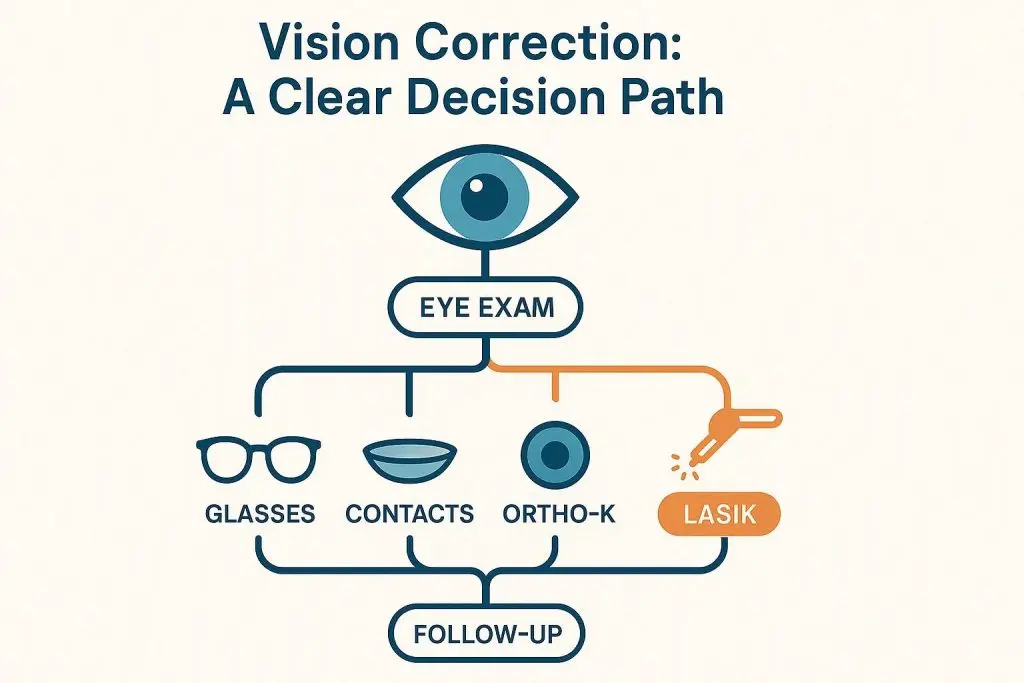
Deciding among glasses, contacts, Ortho-K, and surgery requires weighing clinical suitability, lifestyle priorities, risk tolerance, and cost, supported by a structured decision process that begins with a comprehensive eye exam. Key factors include refractive error magnitude, corneal health, age, ocular surface condition, activity level, and desire for permanence versus reversibility.
A practical decision checklist includes confirming ocular health, trialing temporary options when possible, and discussing long-term goals—such as myopia control in children or permanent correction for adults. Insurance considerations and out-of-pocket cost estimates also influence choices, with vision plans often covering exams and some eyewear while surgical procedures may be handled differently.
| Option | How It Works | Pros | Cons |
|---|---|---|---|
| Glasses | External lenses | Low risk, easy | May obstruct peripheral vision |
| Contact Lenses | On-eye optics | Wide FOV, active use | Hygiene-dependent |
| Ortho-K | Overnight corneal reshaping | Daytime freedom, myopia control | Requires monitoring |
| LASIK | Laser corneal reshaping | Permanent correction | Surgical risks, eligibility required |
What Factors Influence Choosing Between Glasses, Contacts, Ortho-K, and Surgery?
Clinical factors such as refractive range, corneal thickness, ocular surface health, and age strongly influence suitability, while lifestyle priorities—sports, screen time, aesthetic preference—and risk tolerance shape patient preference. For pediatric myopia control, Ortho-K or specialty contact lenses may be prioritized, whereas older presbyopes may opt for progressives or multifocal contacts.
Permanent solutions like LASIK require stable refraction and healthy ocular anatomy and are best considered after a thorough clinical workup and discussion of long-term expectations. Clear prioritization of goals guides the recommended pathway.
How Does Eye Health and Lifestyle Affect Vision Correction Choices?
Dry eye disease, blepharitis, or ocular surface abnormalities often necessitate treating the condition before contact lens fitting or surgical consideration, and severe surface disease may contraindicate certain lens types. Occupational demands—night driving, prolonged computer work, or sports—influence lens design and material choices to optimize comfort and safety.
Systemic conditions and medications that affect tear production or wound healing also play into surgical eligibility. Addressing ocular surface health and aligning choices with daily routines ensures better outcomes and sustained comfort.
What Are the Costs and Insurance Considerations for Different Options?
Costs vary widely: glasses and contact lenses have predictable retail and recurring expenses, Ortho-K involves higher initial fitting and monitoring costs, and LASIK has substantial upfront surgical fees but may reduce ongoing eyewear costs. Eyes On Park accepts many major insurances including VSP and Davis for routine vision services, but surgical and specialty procedures may involve different billing pathways and out-of-pocket components.
Patients should verify coverage details for exams, contact lens fittings, and any co-management services, and discuss financing or payment options when considering higher-cost treatments.
What Are Common Questions About Vision Correction Options?
Patients commonly ask about safety, non-surgical alternatives for astigmatism, adaptation times for progressive lenses, and how optometry practices support surgical pathways; concise, evidence-based answers guide decision-making and next steps. Below are focused responses that address these high-priority concerns while clarifying follow-up expectations and practical logistics. Clear guidance helps patients set realistic timelines and ensures appropriate monitoring for safety and efficacy.
What Are the Safest Non-Surgical Vision Correction Methods?
Spectacles are the safest and lowest-risk method of vision correction because they avoid contact with the ocular surface and require minimal clinical follow-up beyond routine exams. Daily disposable contact lenses offer a strong safety profile among contact options due to reduced maintenance-related contamination risk, whereas Ortho-K can be safe when fitted properly and accompanied by strict hygiene and monitoring.
All contact lens modalities require patient adherence to care instructions and timely follow-ups to minimize infection and other complications.
Can Astigmatism Be Corrected Without Surgery?
Yes—astigmatism is routinely corrected non-surgically using toric spectacle lenses or toric contact lenses designed to neutralize cylindrical refractive error, and rigid gas permeable lenses can provide high-quality vision for irregular astigmatism. For challenging cases, specialty RGP fittings or scleral lenses may be employed to mask corneal irregularities.
Surgical options are considered when optical corrections are insufficient or when the patient seeks a refractive surgical solution, but many patients achieve excellent outcomes with non-surgical methods.
How Long Does It Take to Adjust to Progressive Lenses?
Adaptation to progressive lenses typically takes several days to a few weeks, during which patients learn to use head and eye movements to access the correct viewing zones; initial mild distortion or imbalance is common and usually resolves with wear. Proper frame selection, accurate lens measurements, and graduated counseling on usage dramatically reduce adjustment time and improve satisfaction.
If significant discomfort or persistent visual issues occur after a reasonable adaptation period, a refit or lens design adjustment is recommended.
What Is Involved in LASIK Co-Management at Eyes On Park?
LASIK co-management at Eyes On Park includes pre-operative diagnostic testing to assess candidacy, coordination with surgical centers, and scheduled post-operative visits for visual rehabilitation and monitoring. The optometrist performs corneal topography and ocular surface assessment, discusses realistic outcomes, and arranges timing and logistics with the referred surgeon when appropriate.
After surgery, Eyes On Park provides the follow-up visits needed to track healing, manage temporary symptoms, and ensure the visual rehabilitation plan is progressing as expected; patients are advised to schedule a pre-op evaluation to begin the co-management pathway.
How Often Should You Have Eye Exams When Using Contact Lenses or Ortho-K?
Contact lens wearers should have at least annual exams, with more frequent visits if symptoms, fit issues, or ocular surface changes occur, to reduce the risk of complications and to confirm prescription and lens performance. Ortho-K patients typically follow a denser early schedule—initial fitting checks within days, a one-week visit, a one-month visit, and then periodic monitoring every few months—shifting to longer intervals once stability is confirmed.
Timely follow-up ensures early detection of issues and maintains long-term safety for any lens modality.
- Schedule a comprehensive exam to establish baseline ocular health and refractive status.
- Discuss lifestyle priorities and treatment goals with your clinician to align options.
- Trial non-permanent options where possible before committing to irreversible procedures.
These action steps guide patients through a safe and informed decision pathway from evaluation to long-term management and encourage dialogue with eye care professionals.
Our Commitment to Excellence at Eyes On Park
At Eyes On Park, we are dedicated to setting the standard for comprehensive vision care in Gramercy Park, NYC. Our authority stems from a foundation of:
Expert Clinicians
Our team comprises highly qualified optometrists and ophthalmologists with extensive experience in all facets of vision correction, from routine care to complex surgical co-management.
Advanced Technology
We invest in state-of-the-art diagnostic and fitting equipment to ensure the most precise measurements and optimal outcomes for every patient.
Personalized Care
Every recommendation is tailored to your individual needs, lifestyle, and ocular health, ensuring a solution that truly works for you.
Trust Eyes On Park for unparalleled expertise and a clear path to optimal vision.
Frequently Asked Questions
What is the process for getting fitted for contact lenses?
The process for getting fitted for contact lenses begins with a comprehensive eye exam to assess your vision and eye health. After determining your prescription, the optometrist will evaluate your corneal shape and tear film quality. This information helps in selecting the right type of contact lenses for your needs. A trial fitting may be conducted, allowing you to test the lenses for comfort and vision clarity. Follow-up appointments are essential to ensure proper fit and to make any necessary adjustments.
How can I maintain my eye health while using contact lenses?
Maintaining eye health while using contact lenses involves several key practices. Always wash your hands before handling lenses, and follow the recommended cleaning and storage procedures. Replace lenses as directed, whether they are daily, bi-weekly, or monthly disposables. Regularly schedule eye exams to monitor your eye health and ensure your prescription is up to date. Additionally, take breaks from screen time and consider using lubricating eye drops if you experience dryness. These steps help prevent infections and maintain comfort.
What are the potential side effects of LASIK surgery?
While LASIK surgery is generally safe and effective, potential side effects can include dry eyes, glare, halos around lights, and fluctuating vision, especially in the early days post-surgery. Some patients may experience undercorrection or overcorrection, necessitating further adjustments. It’s crucial to discuss these risks with your surgeon during the pre-operative consultation to set realistic expectations. Most side effects are temporary and can be managed with appropriate care, but understanding them helps patients make informed decisions.
How does age affect the choice of vision correction options?
Age significantly influences the choice of vision correction options. Younger individuals, particularly children, may benefit from Ortho-K or contact lenses to manage myopia progression. Adults often face presbyopia, leading to a preference for progressive lenses or multifocal contacts. Older adults may have additional considerations, such as cataracts or other ocular conditions, which can affect surgical candidacy. Each age group has unique visual needs, making it essential to tailor recommendations based on individual circumstances and lifestyle factors.
What should I expect during the recovery process after LASIK?
After LASIK surgery, patients can expect a relatively quick recovery process. Most experience improved vision within a day or two, but complete stabilization may take several weeks. It’s common to have some discomfort, dryness, or light sensitivity initially. Follow-up appointments are crucial to monitor healing and address any concerns. Patients are typically advised to avoid strenuous activities and swimming for a short period post-surgery. Adhering to post-operative care instructions will help ensure optimal results and a smooth recovery.
Can vision correction options be combined for better results?
Yes, combining vision correction options can enhance visual outcomes for some patients. For instance, individuals with presbyopia may use progressive lenses in conjunction with Ortho-K for myopia control. Additionally, some patients may opt for LASIK after trying contact lenses or glasses to achieve permanent correction. Combining treatments can address multiple vision issues simultaneously, but it’s essential to consult with an eye care professional to determine the best approach based on individual needs and eye health.
What are the long-term effects of wearing contact lenses?
Long-term effects of wearing contact lenses can vary based on lens type, wear schedule, and adherence to care guidelines. Properly fitted and maintained lenses can provide excellent vision without significant issues. However, improper use may lead to complications such as dry eyes, infections, or corneal damage. Regular eye exams are vital to monitor eye health and ensure that lenses remain suitable. Many users enjoy the convenience of contact lenses for years, but ongoing care and attention are essential for maintaining eye health.
Ready for Unparalleled Clarity?
Choosing the right vision correction option is a pivotal decision that can profoundly enhance your quality of life. Trust the proven expertise of Eyes On Park to guide you through every step, ensuring a solution perfectly tailored to your unique needs and lifestyle.